

What are the 6 NDT Methods?
Before we dive into the main 6 NDT methods, let’s clarify what NDT is.
What Is NDT?
Non-Destructive Testing is a crucial process across various industries that enables examining and assessing materials and structures without causing harm or damage. It’s like having X-ray vision for inanimate objects, allowing us to see beneath the surface and evaluate their condition.
When it comes to NDT testing, we are well-established members of the British Institute of Non-Destructive Testing and as a team with over 300 years of combined experience, we know plenty about the types of non-destructive testing and how useful they can be. In this article, we’ll cover the six main ones.
By the end of this article, you will should better understand the 6 main NDT methods. If you’d like to learn more, we’ve included links to pages on our site and external sites that go into more detail about each method.
NDT Method 1: Visual Inspection
Definition and Principles
Visual Inspection, as the name suggests, relies on the power of human eyes to identify surface irregularities and defects. It’s the most fundamental NDT method and forms the foundation for all other techniques.
Advantages and Disadvantages
One of the key advantages is its simplicity and cost-effectiveness. It can be used almost anywhere, from construction sites to manufacturing floors. However, its limitations lie in its inability to detect internal flaws, making it less suitable for comprehensive assessments.
Applications of Visual Inspection
Visual Inspection is akin to the first glance at a painting, helping spot obvious issues like cracks, corrosion, or poor welds. It’s widely used in construction, aerospace, and automotive industries.
Learn more about NDT visual inspection here.


NDT Method 2: Penetrant Testing
Definition and Principles
Penetrant Testing involves applying a special liquid, known as a penetrant, to the surface of an object. This penetrant seeps into surface-breaking defects, making them visible under ultraviolet or white light.
Advantages and Disadvantages
A significant advantage is its ability to detect fine cracks and other superficial defects that may escape visual inspection. However, it’s limited to surface indications and requires thorough cleaning after testing.
Applications of Penetrant Testing
It’s like finding hidden treasure on a map. Penetrant Testing is commonly used in aviation, automotive, and manufacturing industries to locate cracks and fissures on metal surfaces.
Want to learn more? Explore more about penetrant inspection and penetrant testing here.
NDT Method 3: Radiographic Testing
Definition and Principles
Radiographic Testing (otherwise known as radiographic inspection) employs X-rays or gamma rays to penetrate and expose objects on film or digital detectors. It creates an image similar to medical X-rays, revealing internal structures and defects.
Advantages and Disadvantages
The advantage is its ability to inspect the internal structure, like inspecting the inside of a sealed package. However, it requires specialized equipment and safety precautions due to radiation exposure.
Applications of Radiographic Testing
Radiographic Testing is used to inspect welds in pipelines, pressure vessels, and even aerospace components, ensuring their structural integrity.


NDT Method 4: Magnetic Particle Testing
Definition and Principles
Magnetic Particle Testing uses magnetic fields and tiny iron particles to identify surface or near-surface defects in ferrous materials. It’s like sprinkling iron filings on a magnet.
Advantages and Disadvantages
It’s highly effective for detecting defects in ferrous materials and offers rapid results. However, it’s limited to ferrous materials and surface or near-surface defects.
Applications of Magnetic Particle Testing
This method is often employed in the aerospace industry to detect cracks in aircraft components and ensure passenger safety.
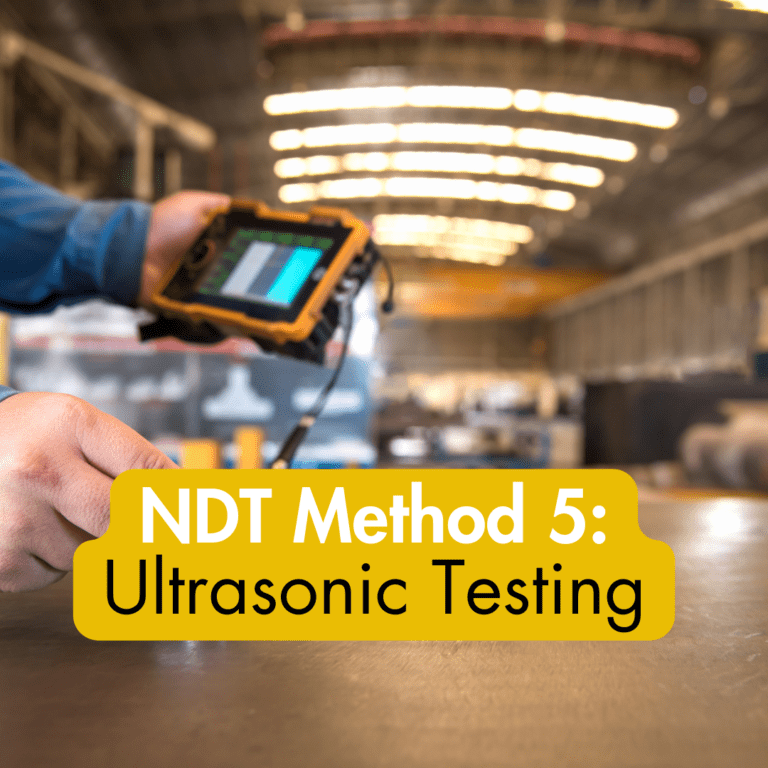
NDT Method 5: Ultrasonic Testing
Definition and Principles
Ultrasonic Testing utilizes high-frequency sound waves to penetrate materials and detect internal flaws. It’s like using sonar to map the ocean floor.
Advantages and Disadvantages
It’s incredibly versatile and provides valuable data about material thickness and internal defects. However, it requires trained technicians and may not be suitable for all materials.
Applications of Ultrasonic Testing
Ultrasonic inspection services help ensure the structural integrity of critical components in industries like energy production and nuclear reactors.

NDT Method 6: Eddy Current Testing
Definition and Principles
Eddy Current Testing relies on electromagnetic induction to assess materials for defects. It’s like magic; eddy currents are induced in the material and react differently when they encounter defects.
Advantages and Disadvantages
It’s quick, sensitive, and can detect a variety of flaws, making it a powerful tool. However, it’s limited to conductive materials and may require complex instrumentation.
Applications of Eddy Current Testing
Eddy Current Testing is often used in aerospace and automotive industries for inspecting conductive materials, like aircraft components and engine parts.
These NDT testing methods are like a toolkit for engineers and inspectors, each serving a unique purpose in ensuring the safety and reliability of various structures and materials. While each method has its advantages and limitations, they collectively contribute to the integrity and quality of countless products and infrastructures. So, next time you board a plane or drive a car, remember the unseen heroes of NDT working behind the scenes to keep you safe.
A summary of the 6 main NDT methods
Summary:
In the vast realm of Non-Destructive Testing (NDT), we’ve uncovered the secrets of six remarkable methods that safeguard the quality and reliability of materials and structures. These techniques serve as the vigilant guardians of our safety, ensuring that the bridges we cross, the planes we board, and the machinery we operate meet rigorous standards.
Visual Inspection, the most fundamental of NDT methods, offers a first glimpse at the surface, unveiling apparent imperfections. Penetrant Testing dives deeper, using special liquids to expose elusive surface defects that might escape the naked eye.
Radiographic Testing steps into the realm of X-rays and gamma rays, giving us a virtual peek into the interior of structures and components. Magnetic Particle Testing employs magnetic fields and tiny iron particles to locate defects in ferrous materials. Ultrasonic Testing uses high-frequency sound waves to map internal structures and defects. Eddy Current Testing harnesses electromagnetic induction to identify flaws in conductive materials.
Each method has its strengths and limitations, making them unique tools in the hands of skilled technicians. From the aerospace industry to manufacturing, these techniques ensure that products and structures meet stringent quality and safety standards.
So, the next time you step onto an aircraft, cross a bridge, or rely on vital machinery, remember the hidden heroes of NDT. They work tirelessly to unveil the secrets lurking beneath the surface, protecting us and upholding the integrity of the world around us.
Last, but not least, if you’d like to talk to our team, feel free to reach out to us. We’ll be more than happy to help.

