

At NDT Consultants, we offer comprehensive Welding Inspection Services to ensure the integrity and reliability of your welds. Our skilled professionals use advanced Non-Destructive Testing (NDT) techniques to identify defects, discontinuities, and potential weaknesses in your welding projects.
With over three decades of experience, NDT Consultants has established itself as a leading provider of welding inspection services in the UK and worldwide. Our commitment to excellence, safety, and customer satisfaction sets us apart from the competition.
We’re also proud members of the British Institute of Non-Desctructive Testing (BINDT). The quality of our work is paramount. We’re ISO 9001:2015 certified, which should give you total peace of mind about the quality of our work and our expertise.
Our certified NDT inspectors are well-versed in various NDT methods, including:
Visual inspection is the most basic yet crucial NDT method for evaluating welds. Our inspectors meticulously examine welds for surface imperfections, weld discontinuities, and overall workmanship.
Magnetic Particle Testing is ideal for detecting surface and near-surface defects in ferromagnetic materials. We utilize this method to inspect welds for cracks, porosity, and other irregularities.
UT effectively detects internal flaws in welds, such as voids, inclusions, and lack of fusion. Our advanced ultrasonic equipment provides accurate and reliable results.
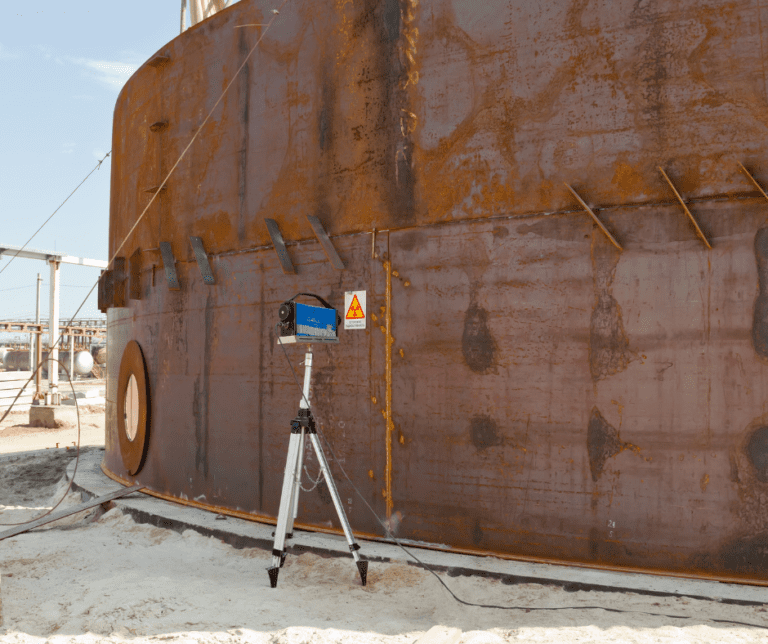
Radiographic Testing uses X-rays or gamma rays to examine the internal structure of welds. This method reveals hidden defects that might not be visible through other inspection methods.
Penetrant Testing is used to identify surface-breaking defects in non-porous materials. Our skilled inspectors apply penetrant agents and analyze the results with precision.
NDT Consultants also offers Eddy Current Testing (ECT) as part of our comprehensive Welding Inspection Services. This advanced NDT method is particularly effective at detecting surface and near-surface flaws in conductive materials, making it highly effective for weld inspections.
ECT involves inducing electrical currents into the material being tested, and our skilled inspectors detect and analyse any conductivity changes caused by defects. With ECT, we can identify issues like cracks, corrosion, and material thickness variations in your welds, providing you with precise insights for optimal welding integrity and safety.
Our Welding Inspection Services play a critical role in ensuring the quality and safety of your welded components and structures. By detecting defects early on, we help you avoid costly repairs and potential failures, providing peace of mind and compliance with industry regulations.
Whether you’re in the automotive, aerospace, or construction industry, our NDT consultants tailor inspection approaches to meet your specific welding requirements. Our expertise extends to various materials, welding techniques, and project scopes.
Ensure the success of your welding projects with NDT Consultants’ unmatched welding inspection services. Contact us today to discuss your inspection needs and experience the NDT Consultants advantage.
Welding inspection is a crucial process that ensures the quality and integrity of welded joints in various structures and components.
Our certified inspectors use a combination of visual inspection, non-destructive testing (NDT) techniques like ultrasonic testing, magnetic particle testing, and dye penetrant testing, as well as destructive testing methods when required.
The inspection assesses weld quality, adherence to industry standards, and compliance with project specifications, helping to identify any defects or discontinuities that could compromise the weld’s strength and safety.
In welding inspection, several types of inspections are conducted to ensure the reliability of welded joints. The main types include:
Visual Inspection: This is the most common and initial inspection method, involving visually examining the weld surface and surrounding area for visible defects, such as cracks, porosity, or lack of fusion.
Non-Destructive Testing (NDT): NDT techniques like ultrasonic testing, magnetic particle testing, and dye penetrant testing are used to detect subsurface and hidden defects without causing damage to the weld.
Destructive Testing: In some instances, destructive testing is performed on weld samples to assess the weld’s mechanical properties, strength, and stress resistance.
Inspecting welding quality requires a systematic approach to ensure the weld meets the required standards and specifications. Our inspectors follow these steps:
Visual Examination: Initial inspection to check for visible defects on the weld surface.
NDT Techniques: Use advanced NDT methods like ultrasonic testing, eddy current testing, radiography, and magnetic particle testing to detect internal flaws.
Dimensional Measurements: Verify that the weld dimensions align with project requirements.
Destructive Testing: If needed, perform tests like tensile testing or bend testing to assess the weld’s mechanical properties.
Inspection before welding is a critical preparatory step to ensure the welding process goes smoothly and produces high-quality welds.
This inspection involves verifying the base materials’ integrity, cleanliness, and compatibility, as well as checking the welding equipment for proper functioning.
Any defects or issues identified during this inspection are addressed before the welding process begins, ensuring a solid foundation for successful welding.
It’s free. Join us!
Middlemarch House
Siskin Drive
Coventry
United Kingdom
CV3 4FJ
OFFICE HOURS:
Monday – Friday: 8:00-17:00
(+44) 024 7651 1151
[email protected]


| Cookie | Duration | Description |
|---|---|---|
| cookielawinfo-checkbox-analytics | 11 months | This cookie is set by GDPR Cookie Consent plugin. The cookie is used to store the user consent for the cookies in the category "Analytics". |
| cookielawinfo-checkbox-functional | 11 months | The cookie is set by GDPR cookie consent to record the user consent for the cookies in the category "Functional". |
| cookielawinfo-checkbox-necessary | 11 months | This cookie is set by GDPR Cookie Consent plugin. The cookies is used to store the user consent for the cookies in the category "Necessary". |
| cookielawinfo-checkbox-others | 11 months | This cookie is set by GDPR Cookie Consent plugin. The cookie is used to store the user consent for the cookies in the category "Other. |
| cookielawinfo-checkbox-performance | 11 months | This cookie is set by GDPR Cookie Consent plugin. The cookie is used to store the user consent for the cookies in the category "Performance". |
| viewed_cookie_policy | 11 months | The cookie is set by the GDPR Cookie Consent plugin and is used to store whether or not user has consented to the use of cookies. It does not store any personal data. |