

Dye Penetrant Inspection (DPI) — also known as Liquid Penetrant Inspection (LPI) — is a non-destructive testing (NDT) technique used to identify surface-breaking defects in solid, non-porous materials. It involves the use of specially formulated dyes to reveal flaws that could affect a component’s safety or performance.
At NDT Consultants, we specialise in delivering expert dye penetrant inspections across industries such as aerospace, automotive, energy, and structural engineering. With ISO 9001:2015 certification and membership in the British Institute of Non-Destructive Testing (BINDT), we bring decades of experience and trusted results.
Dye penetrant inspection is an NDT method that uses liquid dye to detect cracks, pores, laps, and other surface-level discontinuities in materials like metals, plastics, and ceramics.
The process works by allowing a penetrant (a brightly coloured or fluorescent dye) to seep into any defects. After cleaning away the excess dye, a developer is applied to draw out the dye from flaws, revealing clear visual indications of imperfections.
Unlike other methods, dye penetrant testing is limited to surface defects, but it is cost-effective, fast, and highly reliable.
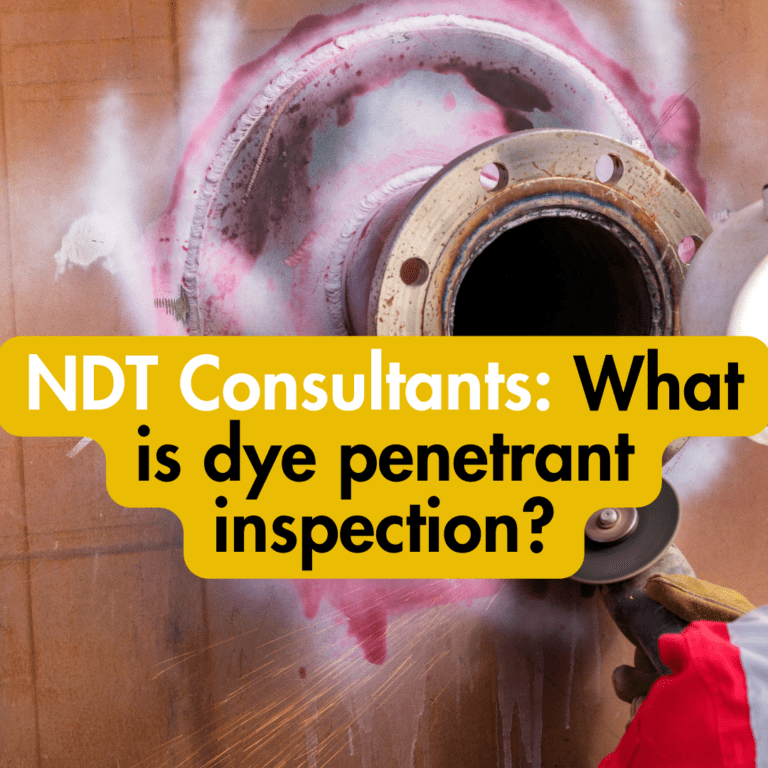
A penetrant is a specially formulated liquid with low surface tension, allowing it to enter fine cracks and gaps. In dye penetrant testing, the penetrant is usually either visible red dye or fluorescent dye, depending on the inspection environment and sensitivity required.
Fluorescent penetrants are typically used under ultraviolet (UV-A) light for increased detection sensitivity, while visible dyes are ideal for field or daylight inspections.
The process of dye penetrant inspection involves several key steps:
Dye-penetrant inspections detect surface-breaking defects in non-porous materials, such as metals, plastics, and ceramics.
They are particularly effective for inspecting components such as castings, forgings, and welds where integrity and safety are paramount.
Dye penetrant inspection is widely used to assess the integrity of:
Welds in pipelines, tanks, and pressure vessels
Aircraft engine components
Automotive parts and castings
Metal structures and support frameworks
It’s especially useful in safety-critical sectors where early detection of cracks or fatigue is essential to prevent failure.
Choosing NDT Consultants for your dye penetrant inspection needs means partnering with a team with deep expertise and a proven track record.
We are very proud of our team of experts, the impact we’ve had on the industry and the difference we make every day. We offer ndt courses, calibration services, ndt consultancy, ndt inspection services and a wide array of ndt testing methods.
Here’s why clients choose us:
Customised Solutions: Tailoured inspection strategies that align with your specific requirements.
Advanced Technology: We have the latest cutting-edge dye penetrant inspection technology to provide high-quality, reliable results.
Experienced Specialists: A team of highly skilled professionals dedicated to maintaining the highest standards of inspection accuracy.
Visit our contact page or explore our NDT courses to enhance your team’s expertise in non-destructive testing.
For those looking to purchase top-quality NDT equipment, check out our NDT equipment supplier page for the best in industry-standard tools and resources.
Dye Penetrant Inspection (DPI), or Liquid Penetrant Inspection (LPI), is a non-destructive testing technique for detecting surface-breaking defects in non-porous materials. It involves applying a liquid dye to an object’s clean surface and allowing it to seep into any flaws. After removing excess dye, a developer draws the penetrant trapped in defects back to the surface, revealing a visible indication of the defect.
Pros:
Cons:
The principle of Dye Penetrant Testing (DPT) is where a liquid (penetrant) with low surface tension is applied to the surface of a material — the penetrant seeps into any surface-breaking voids or cracks. After a developer has been used, it draws the penetrant out of the defects, visibly staining the developer and indicating the presence of a defect.
It’s free. Join us!
Middlemarch House
Siskin Drive
Coventry
United Kingdom
CV3 4FJ
OFFICE HOURS:
Monday – Friday: 8:00-17:00
(+44) 024 7651 1151
[email protected]


| Cookie | Duration | Description |
|---|---|---|
| cookielawinfo-checkbox-analytics | 11 months | This cookie is set by GDPR Cookie Consent plugin. The cookie is used to store the user consent for the cookies in the category "Analytics". |
| cookielawinfo-checkbox-functional | 11 months | The cookie is set by GDPR cookie consent to record the user consent for the cookies in the category "Functional". |
| cookielawinfo-checkbox-necessary | 11 months | This cookie is set by GDPR Cookie Consent plugin. The cookies is used to store the user consent for the cookies in the category "Necessary". |
| cookielawinfo-checkbox-others | 11 months | This cookie is set by GDPR Cookie Consent plugin. The cookie is used to store the user consent for the cookies in the category "Other. |
| cookielawinfo-checkbox-performance | 11 months | This cookie is set by GDPR Cookie Consent plugin. The cookie is used to store the user consent for the cookies in the category "Performance". |
| viewed_cookie_policy | 11 months | The cookie is set by the GDPR Cookie Consent plugin and is used to store whether or not user has consented to the use of cookies. It does not store any personal data. |